
Quarterly Investment Letter
Headwinds and tailwinds
 Russell E. Lundeberg Jr., CPACEO & Chief Investment Officer
Anyone who has ever sailed a boat, flown a plane, or even ridden a bicycle knows about headwinds and tailwinds. The former is a wind that blows against you, slowing you down. The latter blows in the same direction as you are going, speeding you up or enabling you to expend less energy.
This same phenomenon exists in the markets, too.
Every quarter, investors contend with headwinds that push against stocks. Some headwinds are economic, some purely psychological. At the same time, investors must position themselves to take advantage of tailwinds: factors that stimulate growth, stoke enthusiasm, and push stocks higher. When one type of wind outnumbers or out-pushes the other, we experience a positive or a negative quarter. When both are approximately equal, the quarter will end roughly flat.
Q3 was a quarter with a couple of significant tailwinds, but an increasing number of headwinds, too. As a result, the S&P 500 Equal Weight Index was down -1.9%. So, in this message, I want to briefly recap a few of the most important headwinds and tailwinds we experienced last quarter so we can better understand how they might impact Q4. Let’s start with:
Tailwind: Corporate Earnings Growth. Corporate earnings, which are a company’s profits after operating expenses and taxes, have been a major tailwind for the entire year. While we won’t know Q3’s earnings growth until later in the month, it’s expected to be quite high again. That would be quite impressive following on the heels of Q2’s spectacular 53.7% growth rate.1
Corporate earnings are the main way that companies return value to shareholders. So, if investors believe earnings will continue to rise in the future, that expectation can power the markets forward despite fierce headwinds. Headwinds like:
Headwind: Inflation. Rising consumer prices continue to be an issue. While the inflation rate has cooled some compared to what we saw in Q2, prices continue to be elevated. The most recent Consumer Price Index report indicated prices ticked up 0.4% in August compared to 0.1% in July, largely due to higher energy costs and ongoing tariffs.2
Inflation on its own is usually only a weak headwind for the markets. But it matters because it contributes to a more important one: Interest rates. More on this in a moment.
Tailwind: AI. AI has been the ultimate tailwind over the past few years, with a handful of “hyperscaler” companies like NVIDIA, Microsoft, and Google leading the way. AI infrastructure companies, like those that create semiconductors, have also been major contributors. That tailwind continued in Q3, but with less power: Some of the big AI players saw large gains, while others were flat or even down for the quarter. Why did this happen? There are two potential reasons. One is that AI mostly made headlines for all the wrong reasons, with calls to better regulate the industry or slow down the pace of development due to potential safety concerns. The other is that few AI companies are profitable, and most spend hundreds of billions each year while racking up tens of billions in debt in order to finance their spending.3 That’s especially important right now due to the next headwind.
Headwind: Rising debt and interest rates. AI companies aren’t the only things in debt: Our nation is, too. In fact, our national debt hit the $40 trillion mark in August.4 This, combined with inflation, drove Treasury bond yields to twenty-year highs in September, which in turn has caused interest rates to spike. (The Federal Reserve has also recently hiked interest rates to combat rising inflation.)
Higher interest rates can be a headwind for stocks because they make it harder for companies and investors to access or pay back financing. That, in turn, requires them to be more careful with capital, which can slow down growth. Keep an eye on this storyline, because it’s likely to be one of the most important in Q4.
Tailwind: Post-Midterms. Speaking of Q4, let’s look ahead to a possible tailwind: Midterms. Now, the results of midterm elections don’t typically have a significant impact on the markets, but putting the elections in the rear-view mirror often does. In fact, between 1980 and 2025, the U.S. stock market has averaged a return of 8.7% in the twelve months before a midterm election, and 17.5% in the twelve months after.5 That’s because the midterms themselves bring all sorts of uncertainty regarding which party will be in power and what policies they’ll employ. Uncertainty is the ultimate headwind, so once it gets removed, it can feel like a wind at your back for investors.
Headwind: Market Concentration. I mentioned earlier that corporate earnings growth has been high in 2026. That’s true, but it’s also a little simplistic. While some companies have grown tremendously in recent quarters, many have not. As of the end of September, 44% of the stocks in the S&P 500 are “down at least 20% from their 52-week highs.”6 In other words, nearly half of the stocks in the S&P are actually in bear market territory. That’s a major drag on the markets as a whole. Based on market capitalization, AI or AI-related companies now account for nearly half of the weight in the S&P 500. That means that the market’s growth, while impressive on the surface, may have very shallow roots.
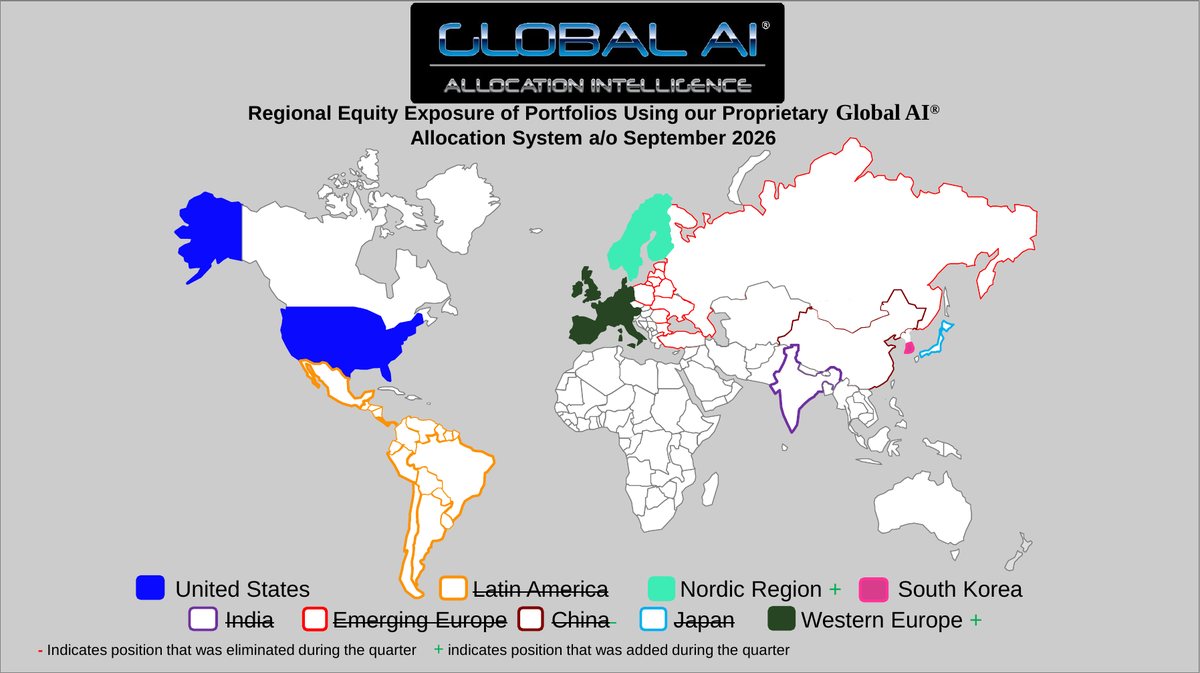
So, there you have it. A quarter where the markets were buffeted back and forth by both headwinds and tailwinds. It’s impossible to know which way the wind will blow in Q4, which is why we’ll continue to rely on Global AI® to help guide our portfolios. Because Global AI® is systematic, it brings a consistent, repeatable process to managing portfolios and helps us maintain discipline, even when headlines and emotions are pulling in every direction. By preparing for all directions, we can cruise when we can and tack when we have to. In the meantime, have a great quarter, and a happy holiday season!
Sincerely yours,
Russell E. Lundeberg Jr., CPA
CEO & Chief Investment Officer
Barrett Capital Management, LLC
Sources
- “If a bruising third quarter can’t halt Wall Street, what can?” (opens in a new tab)
- “Consumer Price Index, August 2026,” (opens in a new tab)
- “The AI buildout rests on hidden debt,” (opens in a new tab)
- “What is the national debt?” (opens in a new tab)
- “How midterm elections affect the stock market,” (opens in a new tab)
- “You might be shocked by how many stocks are in a bear market right now,” (opens in a new tab)
This communication is for informational purposes only and contains a description of some of the factors which Barrett Capital Management, LLC considers in forming its investment strategy at the time of publication. The information herein is subject to change without notice. This is not a solicitation to participate in any investment strategy. Past performance is no guarantee of future results. Reproduction or distribution of this material is prohibited and all rights are reserved.